The goal of open-world games is to recreate a sense of freedom. Many developers make the mistake of assuming that an open world automatically translates into freedom. They believe that bigger is better, or that graphical fidelity alone can make a world feel immersive. But neither of those factors comes close to guaranteeing success. In fact, they can work against a game when its world fails to generate enough curiosity to justify its size.
Assassin’s Creed Black Flag was the last game in the franchise that I truly fell in love with. Now that I’m playing Black Flag Resynched, I’m reminded why the Caribbean is still one of the greatest open worlds I’ve ever explored.
Curiosity Is Rewarded In Many Ways

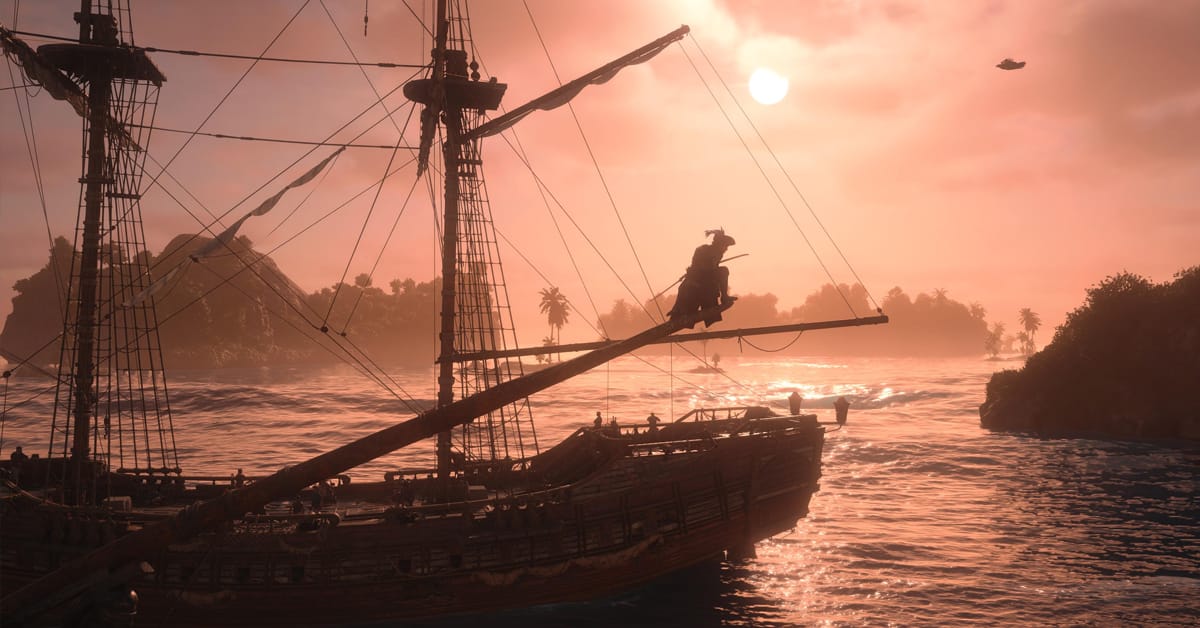
Black Flag delivers exactly what it promises: it gives you the sense of freedom you’d expect as the captain of your own ship. It constantly tempts you to stray from the main path the game has laid out for you, encouraging you to search every island until you’ve found every outfit, weapon, and bottle of rum. Meanwhile, ships drift across the horizon, practically begging to be plundered.
You then use your hard-earned loot to upgrade your ship, the Jackdaw. Better weapons, stronger sails, and ship upgrades don’t just come from progressing through the story. Black Flag constantly encourages you to seek them out yourself by letting the wind decide where you go next.
Black Flag is a game that rewards curiosity. I’ve never stopped at an island only to think, “I might as well have sailed right past this place.” During some of my very first detours, I already found a legendary outfit, better swords, and a stronger pistol.
You’ll also regularly come across wildlife that you can hunt for crafting materials. Resources are scattered throughout the Caribbean, constantly giving you reasons to expand your arsenal. And I’m not just talking about weapons. More importantly, I’m talking about your crew’s growing collection of sea shanties.
Open-World Games That Make Fast Travel Feel Unnecessary Deserve Extra Credit

I can think of very few open-world games where I use fast travel so little. Marvel’s Spider-Man is one of the exceptions. Swinging through its beautifully recreated New York City simply feels too good to skip. Black Flag gives me that same feeling. Sailing across the waves towards my next destination while my crew belts out sea shanties is simply too enjoyable. Did I mention I’m a fan of those?
Every time I step aboard the Jackdaw and take the helm, I feel a genuine sense of anticipation. An endless stretch of ocean lies ahead, and I know I could stumble upon any number of unpredictable adventures. Towering storms with breathtaking waves. Naval battles against unfortunate ships that happen to cross paths with me and my crew. Hunting a massive bull shark. You never quite know what’s waiting beyond the horizon and relying too heavily on fast travel robs the game of that sense of freedom and unpredictability.
In Assassin’s Creed Black Flag, the journey is every bit as important as the destination. Once again, the game excels in one of the most important aspects of open-world design.
Of Course There Are Restrictions, But Black Flag Lets You Choose Them

Eventually, you’ll have had your fill of distractions and decide it’s finally time to tackle another main mission. That’s when the game puts you back on the rails. Missions often revolve around eliminating specific targets, tailing people or ships, or fighting groups of enemies.
Those missions offer far less freedom, and that’s perfectly fine. Ubisoft essentially gives you two different experiences: the freedom of the open sea and the more structured experience of the main story. Most importantly, it only limits your freedom when you choose to let it.
Once a mission ends, the decision is yours again. Do you continue following the story, or do you return to the freedom of the Caribbean? You hold the wheel, quite literally, and that alone reinforces the feeling that you’re always in control.
It’s precisely because everything surrounding the main story feels so liberating that I don’t mind its more linear mission design. If anything, it offers a welcome change of pace before the game hands control back to me and lets me decide what comes next.
Black Flag Earns That Freedom
That, perhaps more than anything else, is Assassin’s Creed Black Flag’s greatest strength.
Many open-world games try to give players as much freedom as possible, but they forget that freedom has to be earned. A massive map means very little if all you want to do is fast travel across it. A beautiful world loses much of its impact if it never gives you a reason to stray from the path.
Black Flag does exactly the opposite. It makes me want to wander. It makes me chase a ship on the horizon just to see where it leads. It makes me dock at an island without having the slightest idea what I’ll find there. It even makes me deliberately ignore the fast travel option, because the journey itself has become part of the adventure.
As a result, Black Flag does something that few modern open-world games still manage to achieve: it respects my time. Every time I choose to follow my curiosity instead of the next objective marker, I know there’s a good chance I’ll discover something worthwhile. Sometimes it’s a new weapon. Sometimes it’s hidden treasure. Sometimes it’s resources for the Jackdaw. And sometimes it’s simply another memorable voyage across the Caribbean while my crew sings one of my favorite sea shanties.
“By the time I decide to continue the story, it feels like my decision rather than the game’s.”
Perhaps that’s why I never find the game’s linear main missions frustrating. Not because they’re flawless, but because Black Flag has already shown me, time and time again, just how rewarding it is to chart my own course. By the time I decide to continue the story, it feels like my decision rather than the game’s.
And that’s exactly why, thirteen years later, Black Flag still feels like one of the greatest open worlds ever created. Not because the Caribbean is the biggest map, nor because it’s the most graphically impressive one (although Resynched certainly helps in that department). It’s because the game understands something that many modern open-world titles seem to have forgotten.
Freedom doesn’t have to mean that a game doesn’t have restrictions.
It’s about giving players the freedom to decide when they’re ready to embrace them.