

*A review code for this game was provided by the developer.
I’ve been asking for more detective games for as long as I can remember. With Death at Fleming Manor, developer SUPERTHUMb has answered my prayers. Granted, you play as a coroner rather than a detective, but the game offers exactly the kind of investigative gameplay I’ve been craving. Examine accident and crime scenes, gather clues, piece together what really happened, and ultimately complete the death certificates.
Death at Fleming Manor had me hooked for hours on end. According to the developer, a playthrough takes around 12 hours, but I spent so much time obsessing over the smallest details that it took me roughly 20 hours to finish.
This review is entirely spoiler-free.
A coroner caught up in a series of mysterious deaths
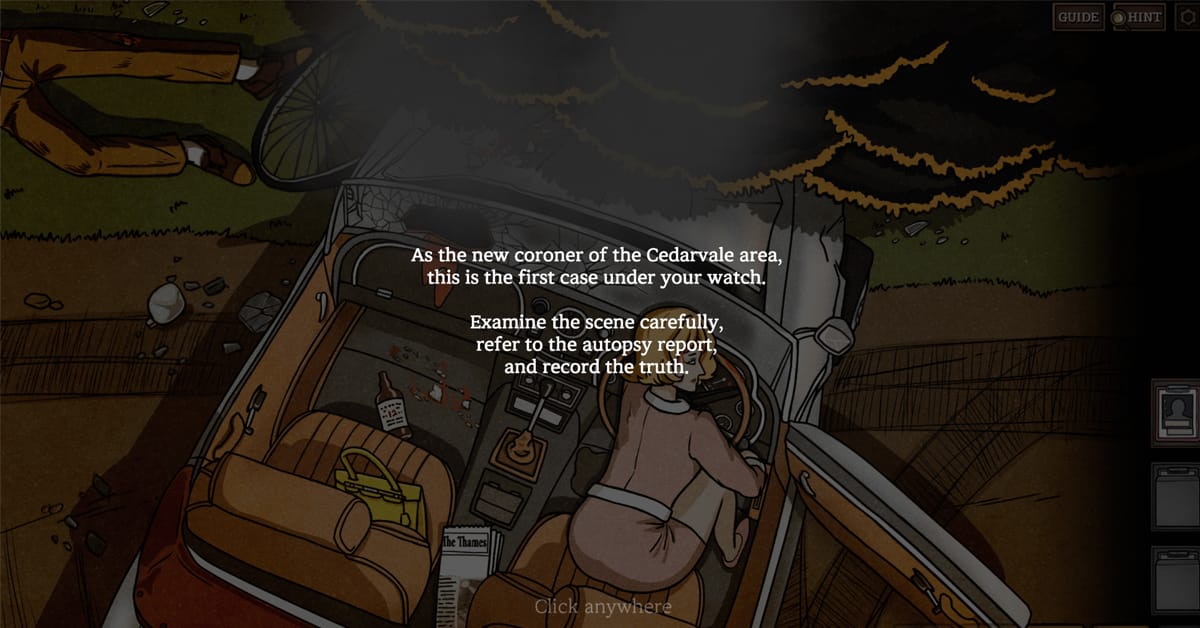
You play as Edgar Whitmore, a newly appointed coroner. Set in 1959, the story revolves around a series of mysterious deaths connected to Fleming Manor, a country estate just outside London.
While the gameplay may be the most engaging aspect of Death at Fleming Manor, don’t underestimate its overarching narrative. Where many investigation games focus on standalone cases, Death at Fleming Manor weaves its individual mysteries into one fascinating larger story.
What begins as an investigation into an apparent collision between a car and a cyclist soon turns into something much bigger. Feuding heirs, gruesome wartime experiments, and a deadly circus act? Nothing is quite what it seems. As a result, I wasn’t just trying to figure out what had happened in each of the game’s 12 episodes. I was constantly trying to piece together how every case fit into the bigger picture.
Expect plenty of mystery, twists and turns, and revelations you probably won’t see coming.
Every episode brings you closer to the truth
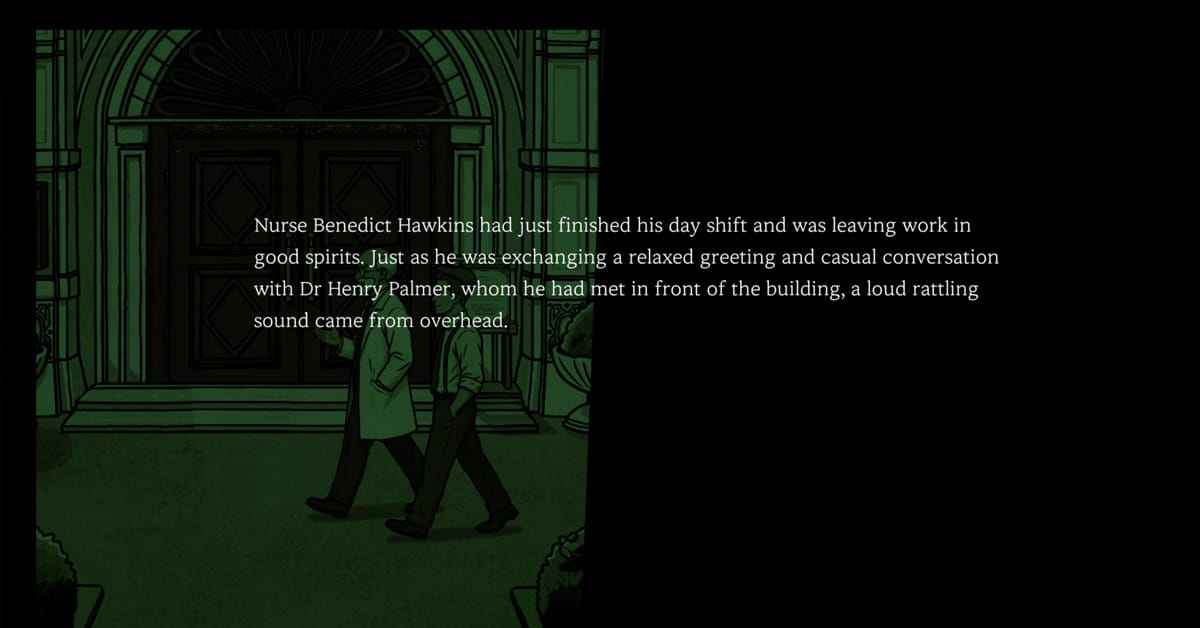
The story unfolds in several different ways. Naturally, much of it is revealed through the investigations themselves, with each completed case shedding more light on what has been happening. But there are also cutscenes between episodes, conversations with colleagues and your employer, and occasional flashbacks that provide additional background information.
The pacing of these revelations is excellent. Not once did I finish an episode wondering what I’d actually accomplished. Everything I did felt like another step toward uncovering the truth. The writing is strong, with compelling characters, motives, and an intricate mystery that wouldn’t feel out of place in a great detective novel or crime thriller.
Another benefit of having all the cases connected is that you gradually become more familiar with the characters involved. Rather than overwhelming you with an endless stream of names and details, Death at Fleming Manor allows you to develop a clearer understanding of who’s who as the story progresses. The more you get to know these characters, the easier it becomes to keep track of everything.
And that’s a good thing, because the investigations themselves are complicated enough already.
Gathering clues had me coming up with all sorts of theories. None of which turned out to be right.
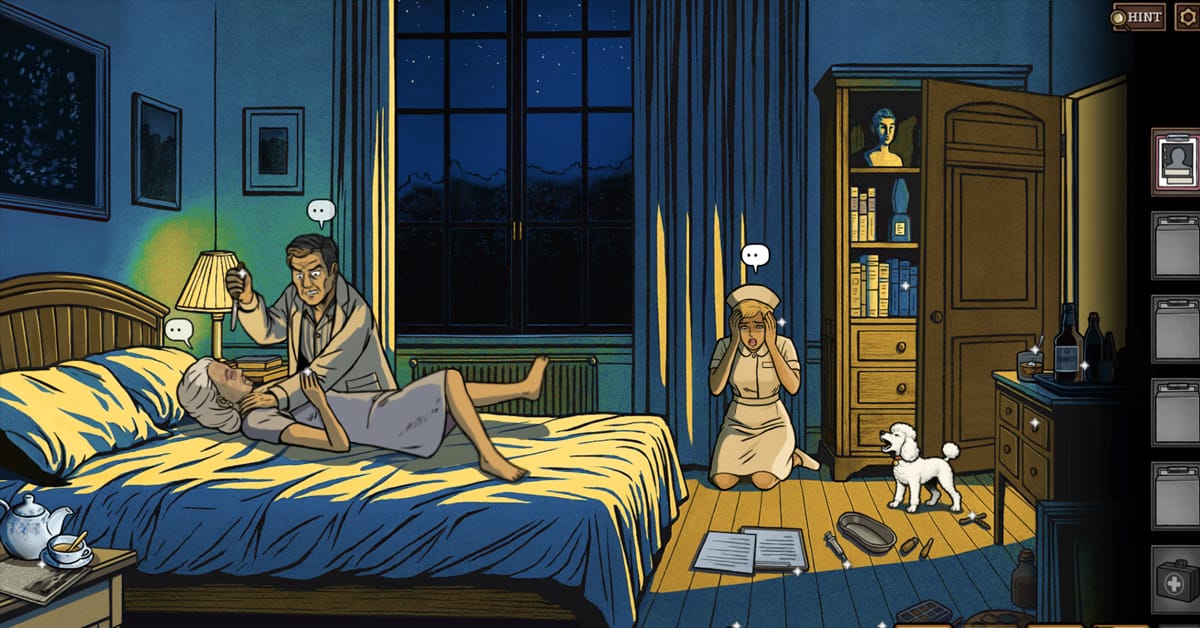
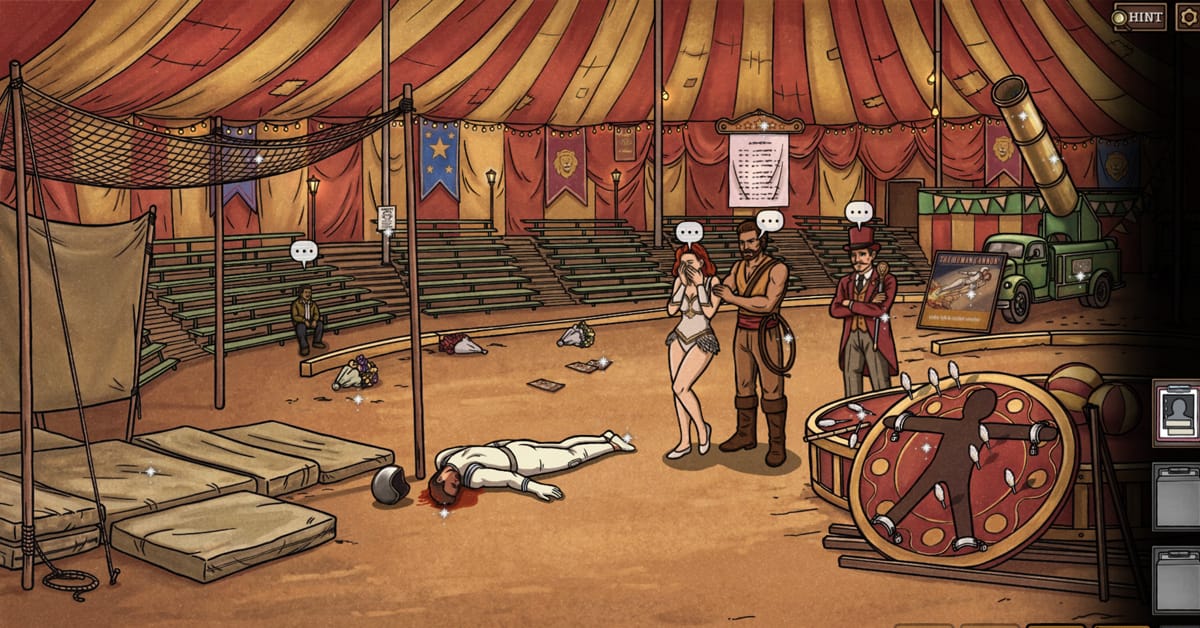
As complicated as the cases eventually become, the first step is surprisingly straightforward. You begin each investigation by searching for evidence, clues, names, and relevant information. The game presents you with the scene of the incident and tells you how many clues there are to discover, usually somewhere between 20 and 60.
These scenes can consist of multiple perspectives, locations, and sometimes even different points in time. Small, flashing asterisks indicate places where you can uncover information. This could be anything from injuries on a victim’s body to letters, identification documents carried by witnesses, nearby flyers, employee rosters, newspapers, or all sorts of other objects.
The actual clues are underlined, and clicking on them adds them to your collection, allowing you to use them later when completing the death certificates. You also carry a handbook packed with information about different types of injuries, poisons, blood types, fingerprints, and much more. Here, too, you can collect relevant information by clicking on underlined terms.
“By the time I uncovered what had actually happened, I often discovered that my initial theories couldn’t have been further from the truth.”
I often caught myself coming up with theories during this initial stage. Oh, there’s a barely smoked cigar lying next to the victim. And in another room, I find a cigar box with one cigar missing. Obviously, that person poisoned the cigar. Case closed. Easy.
Except things are rarely that straightforward in Death at Fleming Manor. By the time I uncovered what had actually happened, I often discovered that my initial theories couldn’t have been further from the truth.
Once you’ve gathered all the available information, it’s time to tackle the next piece of the puzzle. And that usually means paying a visit to our friend, Avery Quinn, in the forensic lab.
Examining the victim often sheds new light on the case
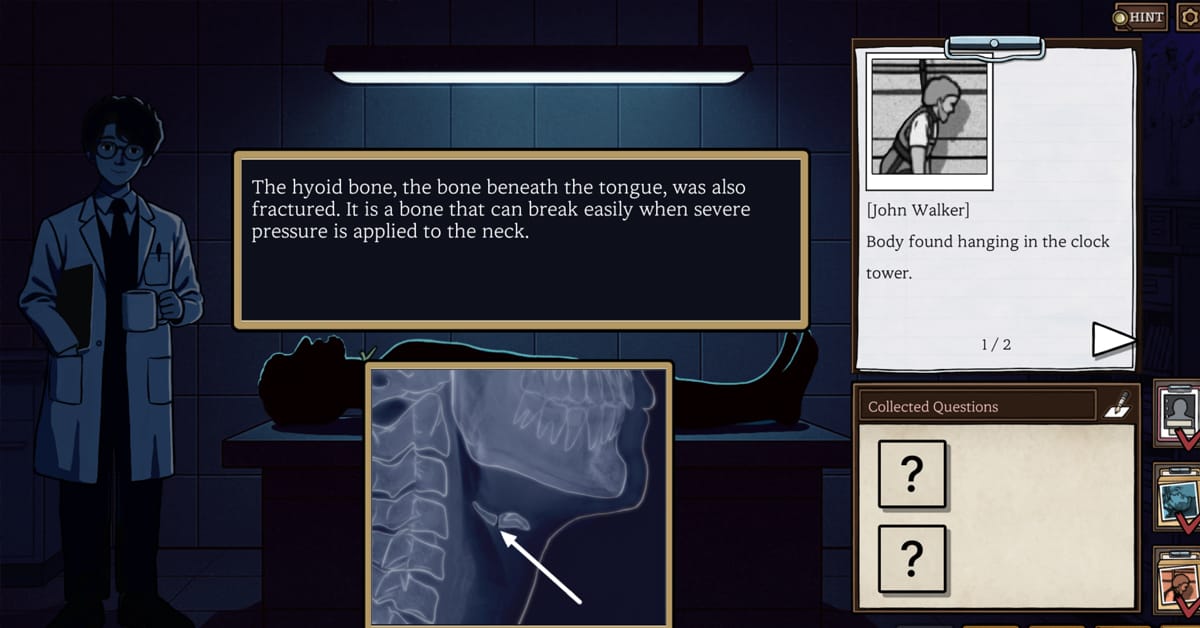
Theories can only get you so far, and in my case, well…usually not very far at all. Fortunately, once we’ve gathered our clues, we can turn to our rather talkative forensic analyst for help. The victim’s body is laid out in the lab, and once again, those flashing asterisks appear.
By clicking on different parts of the body, we can learn more from the analyst. The nice thing about this stage is that we’re finally dealing with actual evidence rather than my (highly inaccurate) theories.
Think of the kind of forensic findings you’ve probably seen in shows like CSI or NCIS. A victim found in the water has no water in their lungs, suggesting they were already dead before ending up there. A fatal wound to the back of someone’s head was caused by a thin, sharp object, delivered at an angle that suggests the attacker must have been left-handed.
These findings are often fascinating, and when combined with the clues you’ve already collected, they reveal a significant part of what happened while giving your brain plenty more to work with.
Investigations stay fresh as Death at Fleming Manor continually introduces new mechanics
There’s much more to these investigations than gathering clues and examining bodies. You’ll regularly need to consult the handbook I mentioned earlier to compare your findings. Sometimes, the game sends you to the blood lab to analyze samples, such as comparing blood found on a weapon with that of the victim or people nearby.
Other times, you’ll be examining footprints, which can prove essential when establishing a time of death. If the weather report indicates heavy rainfall during the night, for example, you can deduce that any footprints left before the storm would have been washed away. You might also find yourself writing a request for further analysis of a particular poison, specifying which object you suspect might contain it.
“Every new mechanic fits seamlessly into the investigation and the surrounding narrative developments.”
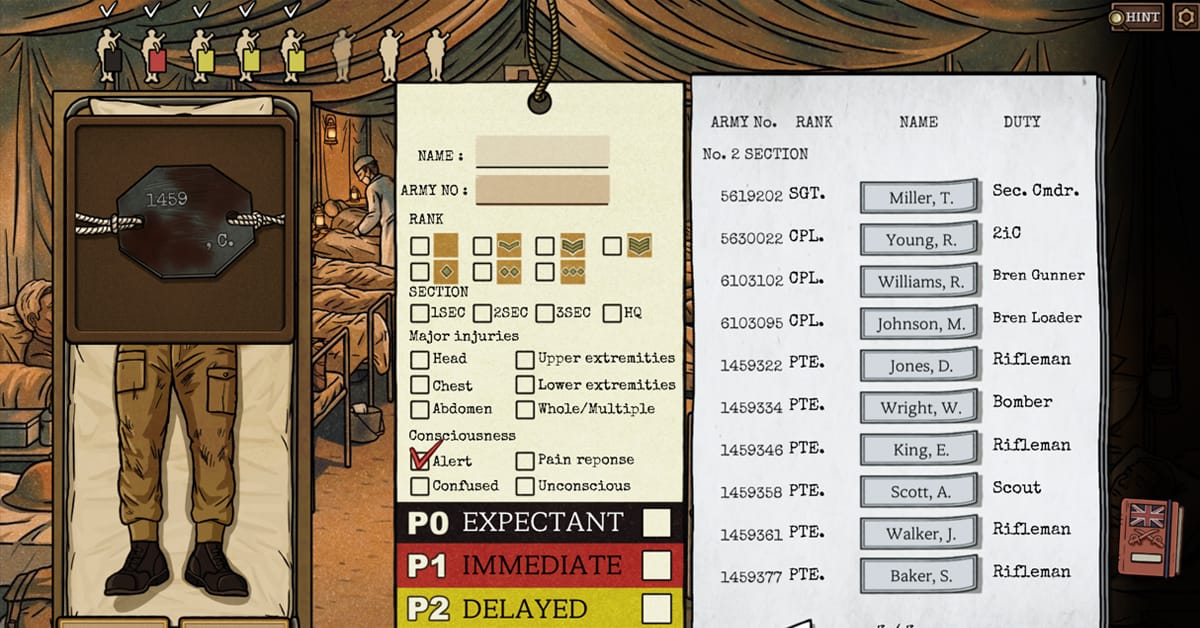
At one point, a flashback had me compiling medical records for wounded soldiers during a war. Which name belongs to which casualty? That’s not always easy to establish when a soldier’s dog tag has been broken or burned beyond recognition. Is the soldier conscious and responsive? Do their pupils react to a flashlight? What’s the extent of their injuries? Is surgery still worthwhile, or are their wounds so severe that they’ll never properly recover?
Death at Fleming Manor always seems to have another trick up its sleeve, and every new mechanic fits seamlessly into the investigation and the surrounding narrative developments. It keeps things varied, ensures the gameplay never grows stale, and constantly challenges you to stay sharp and pay attention to every little detail.
Once you’ve gathered the evidence, it’s time to complete the death certificates
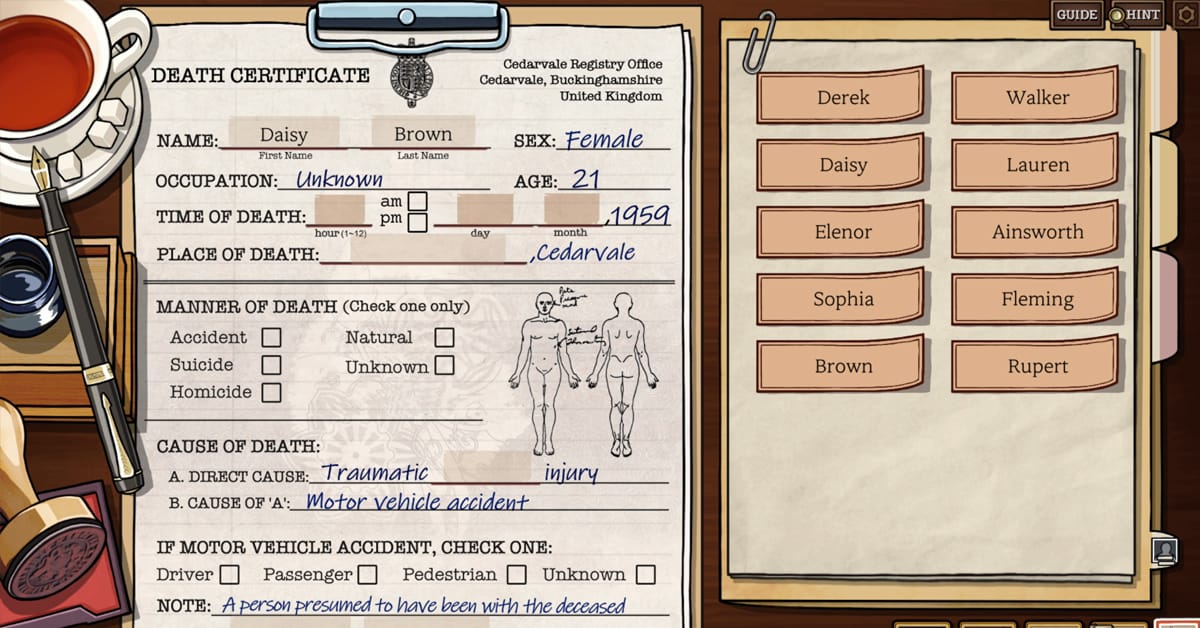
After doing your best to gather as much information as possible, it’s time to start filling out the certificates. The first is usually fairly straightforward, beginning with identifying the victims and any other people involved. This information is often easy enough to find through conversations or personal belongings. Sometimes, though, a bit of cross-referencing is required. You might initially know someone only by their initials, for example, meaning you’ll need to investigate further and rule out other possibilities before establishing their identity.
But that’s where the real work begins. Completing the death certificates can become incredibly complicated. You’ll need to provide details such as when the body was discovered, the time of death, and the cause of death. And if you suspect poisoning, simply selecting “poisoning” won’t cut it. What kind of poison was used, and what evidence supports your conclusion? You fill in these documents by dragging the clues and terms you’ve collected, which essentially form a dictionary of evidence, into the appropriate fields.
And things only get more complicated from there. Later in the game, you’ll find yourself completing multiple certificates within a single episode, with the game increasingly challenging your theories and demanding that you justify your conclusions. The cases became so complex that I rarely managed to solve them correctly on my first attempt. But was that down to me, or the way SUPERTHUMb designed its mysteries?
Reviewing an investigation game is tricky. Are the cases too difficult, or am I just… too dumb?
Of all the genres out there, detective and investigation games must be among the hardest to balance in terms of difficulty. Plenty of other games let you choose between easy, normal, and hard (though developers have certainly come up with increasingly creative names for those settings over the years). Investigation games don’t really have that luxury. Their difficulty largely depends on how clues are distributed and how clearly players can interpret the information they’re given.
For the most part, Death at Fleming Manor gets this right, although there were plenty of moments when it felt like the Soulslike of investigation games. I rarely managed to solve a case on my first attempt. But whenever I reluctantly, and with a heavy heart, pressed the hint button, the resulting clue almost always made me think: I absolutely could have figured that out if I’d just tried a little harder. Incidentally, the game offers optional hints for some of the trickiest fields on your certificates, but not for every piece of information you need to uncover.
Fortunately, you get unlimited opportunities to complete the death certificates correctly. Your “lives” are represented by sugar cubes. Every time you submit a certificate containing one or more mistakes, one of the three sugar cubes resting on your tea cup disappears. If you still haven’t solved everything after three attempts, you can click the cup again to highlight the fields you’ve filled in incorrectly. This means you’ll always have a way to work toward the correct answer, preventing you from getting completely stuck.
“There were plenty of moments when it felt like the Soulslike of investigation games.”
Still, I occasionally found it frustrating when I couldn’t finish a case without consulting hints or resorting to that final bit of assistance from the tea cup. It takes away one of the genre’s greatest rewards: the satisfaction of solving a complicated mystery entirely on your own. But I don’t necessarily hold that against the game’s design. I’m sure there are far better coroners out there than me who would have reached the right conclusions without any help.
One thing I can and will, however, hold against the game is that some of its visual references aren’t always clear enough. I’m talking about things like floor plans and illustrations in your handbook, including snakebite patterns and fingerprints, which you’re supposed to match with evidence found at crime scenes. I didn’t always feel these visual references resembled their corresponding evidence closely enough, making it unnecessarily difficult to connect the dots.
Some Loose Scraps
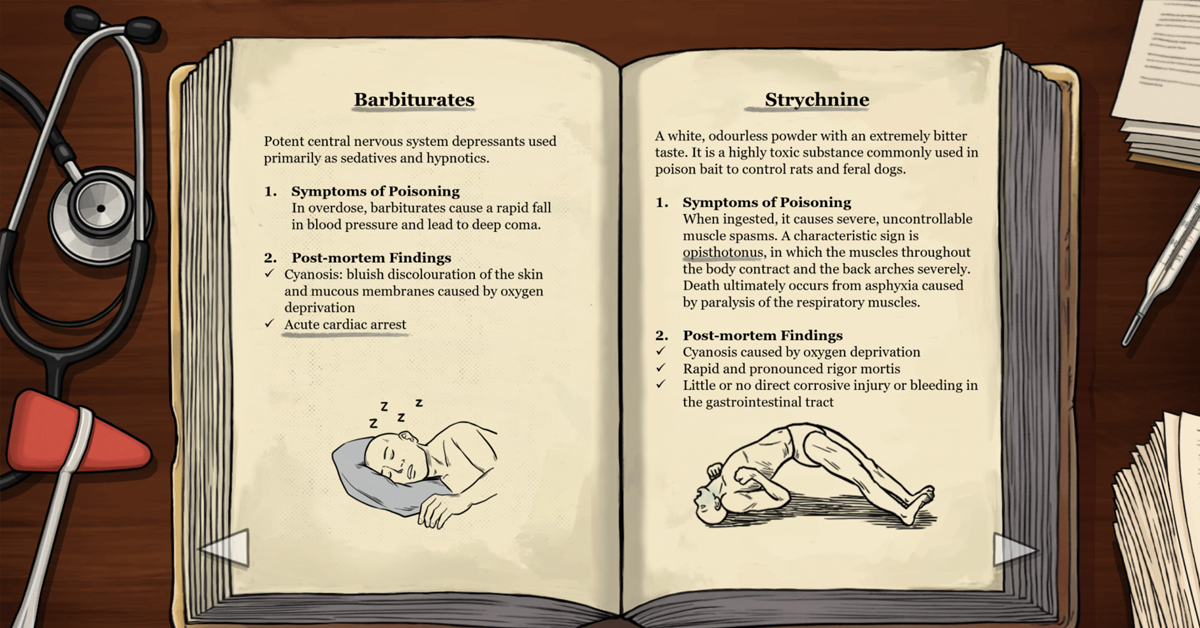
- Death at Fleming Manor isn’t just entertaining, but surprisingly educational, too. Even some of the most bizarre events mentioned in the game are based on real-world history, and much of the biological information in your handbook is scientifically accurate.
- Even after the credits have rolled, the game tests whether you’ve been paying attention by asking you to complete a “credits certificate.” A clever little touch!
- The artwork is inspired by European detective comics from the 1960s.
- The game features four different endings.
- The South Korean studio SUPERTHUMb developed Death at Fleming Manor with a core team of just two people.
- The developers have cited The Case of the Golden Idol, Return of the Obra Dinn, Papers, Please, and The Roottrees Are Dead as inspirations for Death at Fleming Manor.
Conclusion
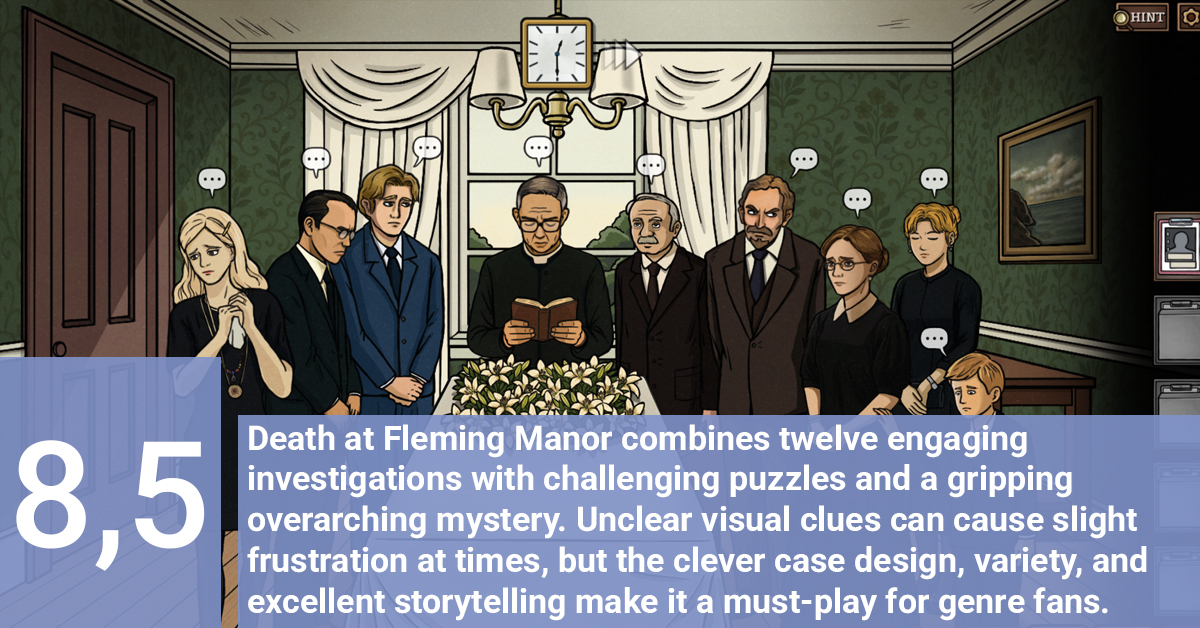
If, like me, you’ve been longing for more investigation games, you really can’t go wrong with Death at Fleming Manor. All twelve episodes offer fascinating and challenging investigations, and successfully completing a death certificate after carefully analyzing every piece of evidence makes you feel like a mastermind.
The game features numerous smaller mysteries woven into one overarching story, and it excels not just in its gameplay, but in its storytelling as well. Hints, clues, and plot twists are carefully introduced and spread throughout the experience, keeping the pacing consistently engaging.
Some aspects of the investigations aren’t always presented clearly enough, particularly when you’re expected to match illustrations from your handbook with evidence found at a crime scene. This adds an unnecessary layer of difficulty to an already challenging game, occasionally turning an otherwise rewarding experience into a mildly frustrating one.
Reviewed on: PC
Score: 8.5/10