
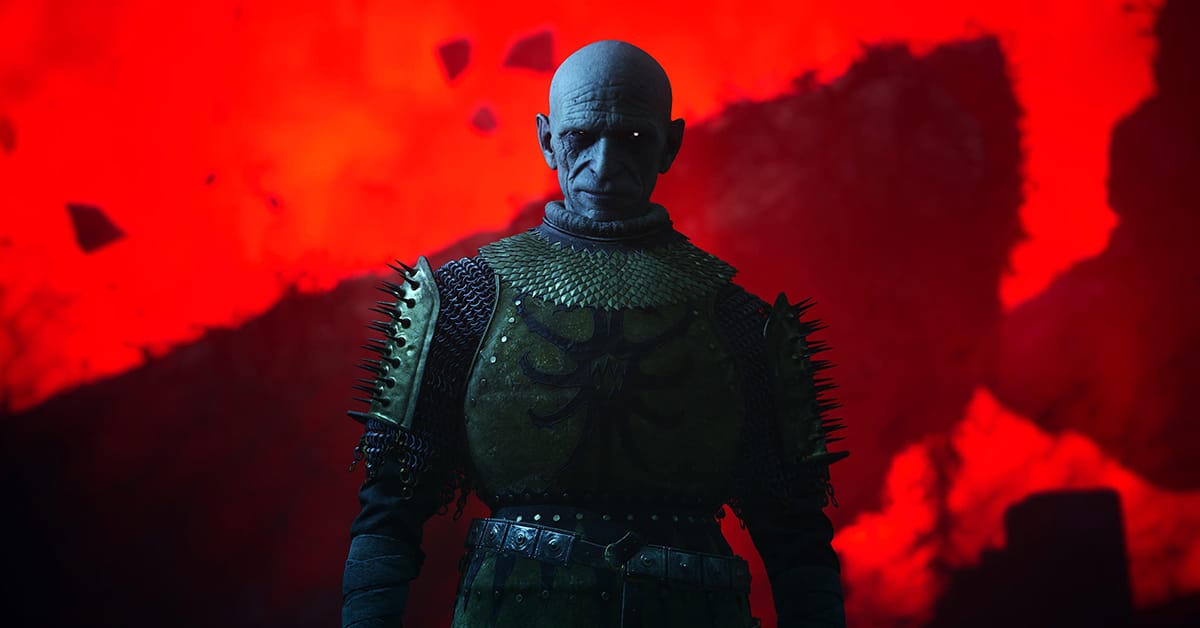
When a vampire bites a human, they essentially create a new version of themselves. Not quite as strong right away, but certainly a formidable competitor in the making. You could say The Blood of Dawnwalker was bitten by The Witcher.
It’s no coincidence, then, that the action RPG was developed by a team that includes several former The Witcher developers. The influences are obvious, and The Blood of Dawnwalker excels in many of the same areas that made The Witcher so special. But does it manage to step out of its shadow, or does the daylight still burn a little too brightly?
This review contains no spoilers.
Donate blood to live disease and tax-free. Where do I sign?

The Blood of Dawnwalker takes place in the fourteenth-century region of Vale Sangora. The Black Death is ravaging the land, and things aren’t exactly going great. Luckily, vampire Brencis is there to save the day. His blood can cure the sick, and to make things even better, the population no longer has to pay taxes. Sounds ideal, right?
Of course, the good man isn’t doing all of this out of the kindness of his heart. In exchange for his protection, Brencis demands that every resident donate their blood once every two weeks. Weaker people have thinner blood, making them worthless in the eyes of the vampires and therefore disposable. It’s a bloody arrangement.
After an encounter with Brencis and his buddies, protagonist Coen is turned into a Dawnwalker. Unlike the ‘real’ vampires, he’s something of a hybrid. During the day, he remains mostly human, but once the sun goes down, his vampiric side takes over. That means vampiric powers, but also the accompanying thirst for blood.
When his family falls into Brencis’ hands, Coen finds himself in a race against time. In thirty days, Brencis will crown himself, with Coen’s family set to serve as part of the sacrifice. That gives Coen exactly one month to grow stronger, find allies and rescue his family from Brencis’ grasp.
The time system made me nervous at first, but by the end I actually wanted more of it

One of The Blood of Dawnwalker’s more unique mechanics is its time system. Day and night each consist of eight time slots. Progressing quests and even unlocking perk upgrades costs time, sometimes a single slot and sometimes several. The prologue leans heavily into this by throwing several quests with tight deadlines at you while giving you only a handful of time slots to complete them.
Do you help that poor grandmother catch the graverobber who dug up her grandson? That will literally cost you in-game time. Would you rather flirt with Anca, the local herbalist? Go right ahead, but you might find yourself without enough time to keep an eye on your family during their fishing trip.
The prologue quite literally forces you to pick your priorities. And I’m not going to lie, that stressed me out. I’m a true completionist, and knowing that I might not see everything during my first playthrough makes me a little nervous.
If you’re reading this and thinking, “That doesn’t sound like something I’d enjoy,” let me immediately dispel the illusion the prologue creates. The game gives you more than enough time to do what you want and complete the quests that actually matter. In fact, I eventually took on Brencis with ten days still left on the clock. By that point, I had scoured the map and pretty much only had generic quests left that wouldn’t add much to my experience.
Despite my initial discomfort with the system, in hindsight I actually wish the game had pushed it even further. Deciding what matters to your Coen while simultaneously sacrificing other opportunities is an interesting concept. On the other hand, I’m also glad I was able to do everything I wanted to do. Because trust me, there isn’t a quest in The Blood of Dawnwalker that you’ll want to miss.
I didn’t play a single quest that made me think, “meh”

Of all the praise I can give The Blood of Dawnwalker, its writing deserves the most. Give me a game with a great story and strong characters, and you’re already well on your way to a high rating on Born for Media (and who wouldn’t want that?).
Generally speaking, I’m not that into vampires. I’ve watched Midnight Mass, my wife forced me to sit through Twilight with her once, and that’s about as far as my experience goes. As far as I’m concerned, vampires belong in the same somewhat unoriginal category as zombies and werewolves. They just don’t do much for me.
That makes it all the more impressive that Coen’s story had me on the edge of my seat from beginning to end. From the overarching moral question of “just how evil is Brencis’ deal, really?” to the personal struggles of Coen and everyone he meets along the way, it was all fascinating. Every conversation, all the good and evil in this world, and especially every shade of grey in between. I believed in it, and I felt like I was part of it.
“I believed in it, and I felt like I was part of it.”
Every quest contributes enormously to the world and its characters. Some give you a better understanding of how the vampire invasion has affected the lives of certain NPCs. Others offer a glimpse into Coen’s family dynamics and how they came to be. And then there are quests that introduce you to Brencis’ sinister lieutenants.
Thanks to the impressive and immersive writing, combined with strong voice acting across the board, not a single quest left me thinking, “I could have spent those time slots on something better.”
And the best part? Through your choices, you can steer many of these stories, both big and small, towards very different conclusions.
What kind of vampire are you?

Throughout The Blood of Dawnwalker, you’re constantly making choices about how Coen responds to the people and situations around him. Your decisions can lead to casualties as early as the prologue, and that trend continues all the way to the end of the game.
What makes this so effective is that it isn’t simply a matter of choosing between A and B and then facing the consequences. Your influence is often much more subtle.
Take a quest where someone asks for your help, for example. You can talk to them and choose to spend a time slot doing them a favour. But how far are you willing to go when helping that person means repeatedly investing more of your precious time? How much does your Coen care about the wellbeing of others besides his own family?
Decide you’ve done enough and focus your attention elsewhere, and that choice might just come back to bite you in the ass. Maybe the next time you decide to pay that person another visit, you’ll find an ambush of Brencis’ men waiting for you, aided by the very person you left hanging. Maybe.
Exploration itself also influences how much the game reveals to you. At one point, I went through a particularly interesting quest investigating a series of gruesome murders. It seemed to reach a conclusion, although I still had my doubts about the outcome.
Hours later, completely by chance, with no quest marker pointing me there at that moment, I stumbled across a remote farm. There, I found another body carrying a note that confirmed my suspicions. There was more to the investigation I thought I had wrapped up hours earlier.
What followed was another fantastic conclusion to the story. In my playthrough, I only discovered it because I happened to wander off and explore this particular part of the map.
I always tried to make my Coen someone who was there for others and held on to his humanity. But you’re also completely free to attack just about any NPC who crosses your path and drain them dry. Pause.
Ultimately, it’s up to you. Is your Coen a patient man who tries to see what little good remains in the world? Or would you rather pick up your sword, bare your claws and start fighting?
Your offensive skillset changes depending on the time of day

Coen’s skill tree is divided into three branches: Witchcraft, Swordsmanship and Vampirism. The first is only available during the day. By investing in the Witchcraft skill tree, you can use hexes to set your enemies’ blood on fire or steal their HP, for example.
At night, the Vampirism tree becomes active. During the eight nighttime slots, you can use Voracious Bite to bite enemies (who would’ve guessed?) and steal their HP. You can also mesmerise enemies and temporarily make them fight on your side, or simply make them explode. The latter in particular felt incredibly badass, often making the remaining enemies panic.
You can also use Voracious Bite outside of combat. Pretty much any human or animal you come across can be promoted to dinner. Rats give you a small health boost, but feasting on larger animals and humans is where you’ll really replenish your health.
Every special skill requires a certain number of activation slots, which you build up by dealing damage and successfully blocking or dodging attacks. During the day, you’ll have to rely on your sword skills, while at night you can switch between your sword and simply tearing into enemies with your claws.
Combat feels great at first, but becomes repetitive towards the end

Sword fighting itself uses an interesting system similar to the directional combat of Kingdom Come: Deliverance. Enemies attack from specific directions, indicated by a subtle on-screen marker. Block at the last moment in the correct direction and you’ll perform a perfect block. Invest in the Swordsmanship tree and you can punish them even harder with a perfect riposte.
You can also dodge in that same direction at just the right moment to perform a perfect dodge. From there, you can deal additional damage by attacking in the direction indicated on screen.
It might take a little while to get used to the system, but once it clicked for me, it really clicked. Combat settled into a satisfying rhythm. My strategy mostly revolved around waiting for enemies to make the first move, landing perfect blocks and hitting them with hard counters. You’ll sometimes find yourself fighting larger groups where two enemies can attack at once, so you constantly have to stay alert. For me, the best offence really was a good defence.
You can stun enemies, but they can do the same to you once your stamina runs out. That rarely happened to me, as consistently landing perfect blocks helps keep your stamina bar topped up. Then again, I played on the default Fair difficulty, so braver players who opt for one of the higher difficulties might have a very different experience.
The lock-on system could use some work

One frustration I did have was the game’s lock-on system. It simply doesn’t work well. It feels like the game decides who you should be targeting rather than letting you choose for yourself. I regularly stunned an enemy, only for the game to decide I wasn’t going to punish them and redirect my attention towards someone it considered a more immediate threat. Pretty annoying when you’re all set to take the stunned enemy’s head off.
Coen’s finishing moves, the animations accompanying his special abilities and the weapon arts tied to certain weapons all look great. The Blood of Dawnwalker absolutely succeeds at making you feel like a badass, especially once you start investing heavily in the different skill trees.
So don’t be like me. At one point, I was sitting on 40 unused perk points because spending them costs time slots. But as I mentioned earlier, you have plenty of those. Don’t be afraid to make Coen stronger whenever you get the chance, so you can enjoy playing him as a superpowered killing machine for longer than I did.
Despite really enjoying the combat system throughout the first half of the game, it started to feel repetitive towards the end. Part of that came down to the lack of enemy variety I encountered, with most of my fights involving humans, spirits, kobolds and far too many wolves and boars.
Most enemies, including bosses, don’t have particularly extensive movesets either. As a result, combat is perfectly competent, but it certainly isn’t one of the game’s greatest strengths. I’m already eagerly anticipating another entry in The Blood of Dawnwalker, and I’d love to see a sequel introduce more weapon sets and a much broader range of enemy types.
And that’s not the only area where there’s room for improvement. Rebel Wolves could also stand to give the technical side of things some more attention.
Room for improvement, especially on the technical side

Of all the choices you make in The Blood of Dawnwalker, there’s one you have to make before pretty much anything else: do you go for Quality, Balanced or Performance mode?
Normally, I almost always go for Performance. Call me a philistine, but nine times out of ten I can barely tell the graphical difference between Quality and Performance mode. Give me the smoothness of 60 FPS instead. Now that’s a difference that even I can actually see.
Naturally, that was my plan here too. What I didn’t expect was for half the forest to suddenly disappear the moment I switched from Quality to Performance mode.
Performance mode strips away a huge amount of vegetation, and it isn’t exactly subtle about it. The difference is so significant that I felt forced to stick with Quality mode. Not a disaster in itself, but the trade-off between the different modes simply isn’t one I’d expect to see from a game released today.
“The camera quickly becomes your biggest and most bloodthirsty opponent.”
Texture pop-in could also be pretty jarring at times. From trees and buildings to moustaches and beards taking several seconds to fully load, it pulls you out of the carefully crafted immersion, which is a shame.
The camera can be an issue during combat as well. One-on-one fights are perfectly manageable, but when Coen gets surrounded by multiple enemies in a relatively small space, the camera quickly becomes your biggest and most bloodthirsty opponent.
Finally, I would have liked to see a redesign of the Quest Log. You accumulate an overwhelming number of quests throughout the game, but there’s no way to sort them by when you acquired them. I spent more time than I’d like scrolling through the seemingly endless list trying to find that one quest I wanted to pursue next. Better separation and some additional categories would have made navigating it much easier.
The good news is that I expect many of these issues, such as the lock-on system and technical performance, to be perfectly fixable. With a few patches under its belt, spending countless hours in this world should become an even smoother experience.
A world that deserves to be seen, and especially heard

The Blood of Dawnwalker’s Vale Sangora is largely brought to life by the diverse cast of people who inhabit it. Visually, the world does what it needs to do. It’s a medieval fantasy setting, and we’ve seen plenty of those before. Vale Sangora isn’t going to win any prizes for originality, but it doesn’t need to.
Far more important is how it feels to explore this world. As I mentioned with an example earlier in this review, exploration can lead you to important conclusions to existing storylines. But it can just as easily be the beginning of entirely new ones.
Quest markers appear on your radar once you get within 100 metres of the relevant location. Some markers are already visible on your map thanks to leads you’ve picked up, while others have to be discovered yourself. You can stumble across them naturally, or use your vampiric abilities at night to climb towers and scout the surrounding area.
Doing so adds question marks for nearby points of interest to your map, which you can then investigate to uncover new activities and quests.
Because the quests are so consistently well designed, I remained motivated to explore as much as possible. And while doing so, I was constantly accompanied by one of the best soundtracks I’ve heard in a long time.
Once again, I can’t help but draw a comparison with The Witcher 3: Wild Hunt. That game has one of my favourite soundtracks of all time, and The Blood of Dawnwalker often sounds remarkably similar, right down to the distinctive yodelling.
The music is exhilarating during combat, while throughout the story it perfectly complements the grim tone that defines Vale Sangora. An absolute treat for the ears.
Some Loose Scraps
Regular readers might know that I often end my reviews with Some Loose Scraps, a collection of random brain spins that didn’t quite make it into the review. Since I recently dedicated an entire Loose Scraps article to The Blood of Dawnwalker, I’ll point you in that direction instead if you’re hungry for some more Dawnwalker scraps!
Conclusion

The Blood of Dawnwalker is an exceptionally well-written game. It’s an art to make every single quest, main or side, fascinating while also having it contribute to the bigger picture. The situations you find yourself in and the characters you meet all come with their own interests and motivations, yet it’s remarkably easy to understand their different perspectives. As a result, the game constantly makes you think about good and evil, and whether it’s even a matter of good and evil in the first place.
The time system, where your actions cost time slots, took some getting used to, but ultimately left me seeing a huge amount of potential. I’d love to see a sequel lean into it even further, giving your choices just that little bit of extra weight.
Combat feels innovative thanks to its directional inputs and is particularly engaging throughout the first half of the game. A lack of enemy variety and movesets causes that novelty to wear off well before the finish line, though.
Technical shortcomings, such as the remarkably large difference between Quality and Performance mode and noticeable texture pop-in, feel like little more than footnotes when weighed against the areas where The Blood of Dawnwalker truly excels. If, like me, you’re here for a great story, fantastically written characters and a world you genuinely feel part of, you might just come away thinking this is the best game of 2026 so far.
So, has The Blood of Dawnwalker managed to step out of The Witcher’s shadow? In my eyes, it has done so with flying colours. It still has some lessons to learn before it can match those exceptional heights, but my expectations for where this franchise can go from here are through the roof.


