It’s the week before the official release of Nioh 3. I boot up the demo, reach the first boss fight, and before I can even say “holy shit,” I’m staring death straight in the eyes. Over and over again I get completely demolished. For a moment I think: I’m not going to do this to myself. But in my endless, noble mission to keep my three readers informed about important new game releases, I decide to take one for the team and buy the full game anyway.
And many hours and deaths later, I can only be glad that I did. On paper, Nioh 3 and I looked like a marriage doomed to end in a bitter divorce. But Team Ninja’s game had an ace up its sleeve that allowed me to set aside many of my personal dealbreakers: some of the best combat I’ve ever played. Possibly the best.
This review contains no spoilers. Not only because none of my reviews do, but also because I understood so little of the story that I wouldn’t be able to spoil it even if I wanted to.
I Accidentally Skipped a Cutscene, but I Suspect My Subconscious Had Something to Do With It

I’m a gamer who values story very highly. Give me a game with a great narrative and mediocre gameplay over the other way around any day. But after spending about 40–50 hours exploring Nioh 3’s open zones, I genuinely couldn’t tell you what actually happened.
What I do know is that it takes place in old Japan, and you play as Tokugawa Takechiyo. Using a solid character creator, you design your own version of the future shogun. At least, that’s the idea. Your younger brother would much rather claim that honor himself and interferes. Just as he’s about to relieve Takechiyo of his head, your guardian spirit Kusanagi intervenes and transports you from the year 1622 back to 1572.
By traveling through different locations across different time periods, you must grow stronger and try to prevent that fate from ever happening. You do this by fighting countless Yokai, demonic enemies, as well as plenty of human foes.
But even this butterfly-effect theme, something I normally love, failed to grab me. When I accidentally skipped a cutscene halfway through the game, I didn’t even bother looking it up on YouTube afterward, which I normally would do without hesitation. I honestly doubt I missed much. None of the characters resonated with me, the voice acting never once impressed me, and I rarely felt as confused about a story as I did here.
Nioh 3 feels like a game that included its story purely for decoration, under the assumption that “well, you need something…”. The fact that I still poured many hours into the game and actually saw it through to the end says far more about what the game does offer. I constantly wanted to be let loose again to face the dangers of the world, gather an overwhelming amount of loot, sharpen my combat skills, and find myself in the most epic boss fights. That’s what Nioh 3 lives and dies by, and it’s more than enough.
Two Completely Different Combat Styles You Can Switch Between With the Press of a Button

Nioh 3 offers two completely different combat styles. With the press of a button, you can switch between Samurai Mode and Ninja Mode. For both styles you can choose from seven unique weapons, each with their own movesets and combos. On top of that, each style has access to specific defensive gear such as armor, footwear, and waistguards.
Samurai is, unsurprisingly, the heavier option. Your weapons deal more damage, and the gear you can equip is heavier and capable of taking far more punishment. On the offensive side you can switch between a faster but weaker low stance, the powerful but slower and therefore riskier high stance, and the mid stance, which strikes a balance between the two. Defensively, you can unlock the parry skill fairly early on, which is essential for the Samurai playstyle.
Ninja Mode, on the other hand, relies on agility. With lower defensive stats, survival depends on an effective mix of your evade skills (the ninja counterpart to parry) and fast offensive combos. Positioning is extremely important here, because landing backstab damage in Ninja Mode gives a significant bonus and can tear through enemy health bars quickly. Ninja Mode also provides additional ranged tools through ninjutsu, allowing you to deal damage from afar with things like kunai or fireballs.
In my experience, Ninja Mode was the most efficient style overall, but there were also plenty of boss fights where the Samurai style ended up carrying me through. I started and finished my adventure using the Samurai’s switchglaive and the Ninja’s kusarigama. During the final 20% of the game, however, I swapped the latter for the ninja sword, which I discovered suited my playstyle much better.
That said, every weapon I experimented with seemed to have its own strengths and weaknesses, and I’m certain that in the right hands any of them can be fully mastered. Respeccing your skills is completely free, which strongly encourages experimenting with the many weapons, skills, and playstyles the game offers. That’s a huge advantage.
I will never understand why so many games punish players for respeccing. It discourages players from engaging with the mechanics developers worked so hard to create, often resulting in people experiencing only a small portion of the gameplay. Team Ninja clearly wants you to experience as much of its excellent combat as possible, and more developers should follow that example.
Combat Feels Like a Mix Between a Chess Match and a Dance

Button mashing is deeply embedded in my gamer DNA. And let me tell you, in Nioh 3 that’s a ticket to a very quick death. Where in most games I’m used to focusing mainly on the health bars of myself and my enemies, the stamina bar (or in Nioh’s case, the Ki bar) is at least as important.
Depending on the weight of your equipment, the number of skill points you’ve invested in Heart, and your chosen attack style, your Ki bar will gradually drain. Attacking with the heaviest weapons in Samurai Mode drains your Ki very quickly. Blocking and dodging do the same, and when you run out of Ki entirely you become temporarily stunned, leaving yourself wide open to enemy attacks.
In Samurai Mode you can recover part of your lost Ki by performing a Ki Pulse. At the end of an attack or combo, a kind of blue glow briefly swirls around your character. If you press the button at the right moment and execute the Ki Pulse correctly, you can immediately recover a portion of the Ki you just spent.
“During every fight you constantly have to make decisions and weigh your risks.”
It took me about half the game before I properly got the hang of it, but timing these pulses well is essential if you want to avoid getting stunned all the time.
During every fight you constantly have to make decisions and weigh your risks. Can I add one more attack to my combo, or will that leave me without enough Ki to block afterward? Do I play it safe and chip away at the enemy so I still have enough Ki to survive the counterattack? And how much Ki does the enemy have left? Because enemies follow the exact same rulebook. They too can be stunned when their Ki runs out.
Whether you’re fighting the regular Yokai roaming the open areas or facing one of the game’s major boss fights, you’re constantly asking yourself these questions. That makes every encounter engaging and rewarding. But Team Ninja isn’t stingy. If you think the satisfaction of the combat itself is the only reward, you’d be mistaken.
Loot, Loot, and Even More Loot

Never before have I had so much loot thrown at me as in Nioh 3. Absolutely everything you do results in a ridiculous amount of loot. Whether you simply kill a standard Yokai, defeat a human enemy (who in most cases serve as little more than fodder), or open a chest, a stream of items will always pop out.
These can be things like elixirs for healing, Soul Cores (special items your Guardian Spirit can use, because yes, those also have usable skills during combat), and of course weapons and armor.
The loot is divided into four different rarities: common, uncommon, rare, and exotic. Each rarity has its own color. Exotic loot is purple, and every time another purple item dropped I got a small dopamine hit. Especially early on, because later in the game you start getting flooded with purple gear as well.
Killing a simple enemy can easily reward you with four or five different items. And since the map is absolutely packed with enemies, you can do the math. While I definitely appreciated the sheer amount of rewards, I did spend a long time dreading the idea of managing all those items.
“Absolutely everything you do results in a ridiculous amount of loot.”
Fortunately, Nioh 3 gives you an inventory that can hold up to 2,000 items. For me, that turned out to be just enough. Only during the final few hours did I start having to drop items more frequently to make room for new treasures.
The game also offers a few options to help you deal with all that loot. For example, you can set the game to automatically exchange any items below rare quality at a shrine (the game’s save points). Not only do you get rid of the items instantly, you’ll also receive some Amrita (Nioh’s version of souls used for leveling up) in return.
That said, if you’re going to give players an inventory limit of 2,000 items, you might as well remove the limit entirely. Even though you collect an absurd amount of loot, most of it isn’t actually better than what you’re already using, and in many cases it’s weapons you don’t even use or gear that simply isn’t worth equipping.
Of course, you’ll still want to collect as much loot as possible in the hope of finding a better version of your weapon or a cooler and more effective set of gear for your Takechiyo. And that’s one of the main reasons you’ll find yourself thoroughly combing through each of the game’s four maps.
The Different Maps Give You Plenty of Ways to Prepare for the Upcoming Boss Fights

The first map, Warring States, is the largest of the bunch, and I easily spent around 20 hours there before unlocking the next one. From that point on the maps become somewhat smaller. One of the four is even very small and linear, but each of them has a unique atmosphere that helps keep the game feeling fresh throughout its considerable runtime.
That’s important, because the standard enemies themselves don’t contribute much to that variety. By the time you reach the third map, you’ve already seen most of them.
Exploring the map feels very organic. When you open the map, you can clearly see the recommended level for each area. Instead of blindly rushing toward my main quest, knowing I’d get my ass kicked mercilessly, I often spent time exploring areas that matched my current level first.
Almost every time I did, I would stumble upon something that gave me a small advantage before my next obstacle. Kodama, for example, are hidden all across the map. These small green forest spirits return to the nearest shrine once you find them. Collecting Kodama can increase the maximum number of elixirs you can carry, and you can also choose bonuses such as faster Amrita gain or improved equipment drop rates.
“Exploring the map feels very organic.”
You may also encounter Scampusses, round Yokai cats that you have to chase for a short while. The biggest reward, of course, is that you eventually get to pet them, but they also tend to lead you toward hidden items and other useful bonuses.

Another creature worth hunting down is the Chijiko. These flying creatures can be recognized by the sound of a small bell. You can shoot them out of the air with your ranged weapon (yes, those are still part of the game too), and they often reward you with Samurai or Ninja Locks. These locks can be used in your Samurai or Ninja skill trees, as well as the skill trees tied to specific weapons. All of those skill trees can be reset as well.
No matter where you are on the map, it pays to keep your eyes and ears open for creatures that can lead you to useful bonuses. The more things you discover in the world such as creatures like the ones mentioned above, enemy bases, or shrines, the higher your exploration level becomes for that region.
And the higher your exploration level, the more icons appear on your map. Every discovery tends to lead to something else that helps make your character stronger.
The Excellent Placement of Shrines Saved Me a Lot of Frustration

While exploring the world and making your way toward your next main objective, you’ll regularly come across Shrines. At these Shrines you can use your collected Amrita to level up, access missions, play in co-op, and do a variety of other things I won’t get into here unless I want this review to become much longer than it already is.
What I do want to highlight before wrapping things up, however, is just how well these Shrines are placed. I’m anything but a cozy gamer, but I’m generally not a fan of games that are overly punishing either. I’ve bounced off quite a few soulslikes because losing a large amount of souls ended up causing more stress and frustration than enjoyment.
That almost never happened to me in Nioh 3.
Shrines are consistently placed in ideal locations, often right before challenging boss fights or close to enemy bases. Because of that, I rarely found myself entering a difficult encounter while carrying a huge amount of Amrita. And when I was working my way through an area toward my next objective, I usually had gathered just enough Amrita by the time I reached the next Shrine to level up.
Thanks to this thoughtful placement, I rarely walked around with a massive amount of Amrita while worrying I might lose it all if I failed to make it back to the location of my previous death.
That kind of tension and risk is something some players may enjoy and might even miss here. For me, though, this worked perfectly. Overcoming the boss fights already provided more than enough challenge without constantly carrying the additional pressure of losing all my collected Amrita.
Some Loose Scraps

- The Burst Break, which lets you parry your enemies’ heaviest attacks with a well-timed style switch, feels so damn good.
- Rarely have I written a 2,800-character review while describing so little of the actual game. Nioh 3 is so packed with mechanics, skills, and collectibles that there’s still a lot more I could talk about.
- Watching other players on YouTube makes it immediately clear how wildly different everyone’s playstyle can be. People are pulling off combos and attacks I had no idea were even possible.
- Maybe it’s time to pick up Elden Ring again, now that I’m better at dealing with a “You Died” screen.
- I haven’t even mentioned one of the coolest mechanics yet: the Living Artifact. Once a certain gauge fills up, you can temporarily transform and deal massive amounts of damage. It looks incredible and can completely shift the balance during a boss fight.
- Your weapons don’t just have their own damage values, they also come with bonuses like increased Amrita gain or resistance to certain elements. Keeping track of everything is absolute madness.
Conclusion
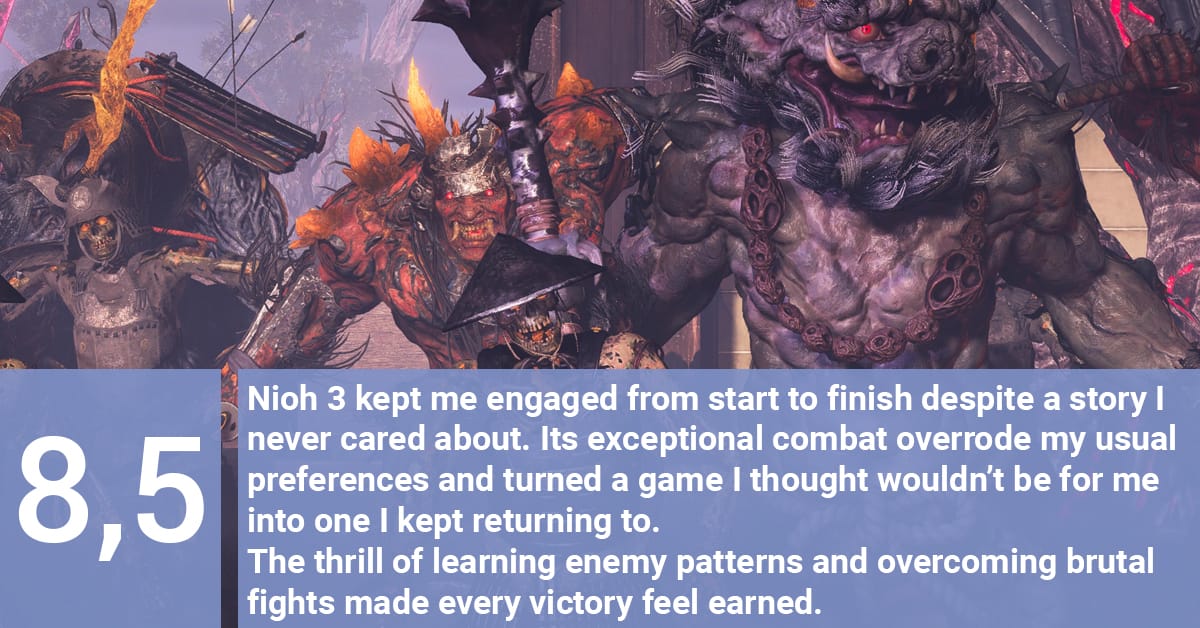
Nioh 3 managed to teach me not to give up, even after dozens of hopeless defeats. It kept me engaged from start to finish despite a story I ultimately didn’t care about at all. Those are two of the biggest compliments I can give the game, because very few titles in my long gaming history have managed to pull that off.
The reason for that is the game’s fantastic combat. It’s so strong that it completely overrode my usual preferences. On paper, Nioh 3 shouldn’t be my kind of game at all, with an uninteresting story and an above-average level of challenge and punishment. Yet I kept coming back, eager to master the combat just a little bit more.
The rush of defeating incredibly challenging enemies was something I had never really experienced before, but now I finally understand what it feels like. I’ve learned to appreciate the satisfaction of recognizing enemy attack patterns and striking at exactly the right moment. And while not everyone considers Nioh 3 a true soulslike, I’m certain that from now on I’ll have a much greater appreciation for the genre.