*A review code for The Necromancer’s Tale was provided.
Fantasy RPGs are, hold your gasps, brimming with fantasy. Your party members usually come from wildly different races and specializations, and together they fight their way through a world where even NPCs are fully aware of the supernatural forces around them.
The Necromancer’s Tale, a narrative-driven top-down gothic RPG developed by PsychicSoftware, manages to stand out on multiple fronts. In this game, black magic stirs painful memories of the past, but it’s believed to have long since faded away. And here’s the twist: this time, you get to be the necromancer, instead of one of your party members (looking at you, Emmerich from Dragon Age: The Veilguard).
Don’t worry: this review, as always, is completely spoiler-free.
A Dark and Intriguing History

You pick either a male or female protagonist and are immediately immersed in a rich backstory detailing the current state of the world. From this point on, one thing is clear: The Necromancer’s Tale is all about text. Lots. And lots. Of text. If that’s not your thing, you might as well cross this one off your list (and what are you even doing reading this 3,000+ word review?).
But if you enjoy deep lore and plenty of dialogue, you’re in for a treat. The intro paints a fascinating history, centered around a war between Rulsthen and the Republic of Venice. With superior finances, Venice seemed destined to crush Rulsthen.
In a last-ditch effort, two brothers and a close friend go searching for a way to turn the tide, and they stumble upon black magic. After a pilgrimage, a mysterious figure hands them an ancient book filled with strange, unknowable symbols. Using its power, they raise an army of the dead.
The tide of war shifts. Venice falls, the book is destroyed, and the undead are returned to… well, being dead.
Not long after, you are born; the child of one of the two brothers.
Shaping Your Childhood, Shaping Your Stats
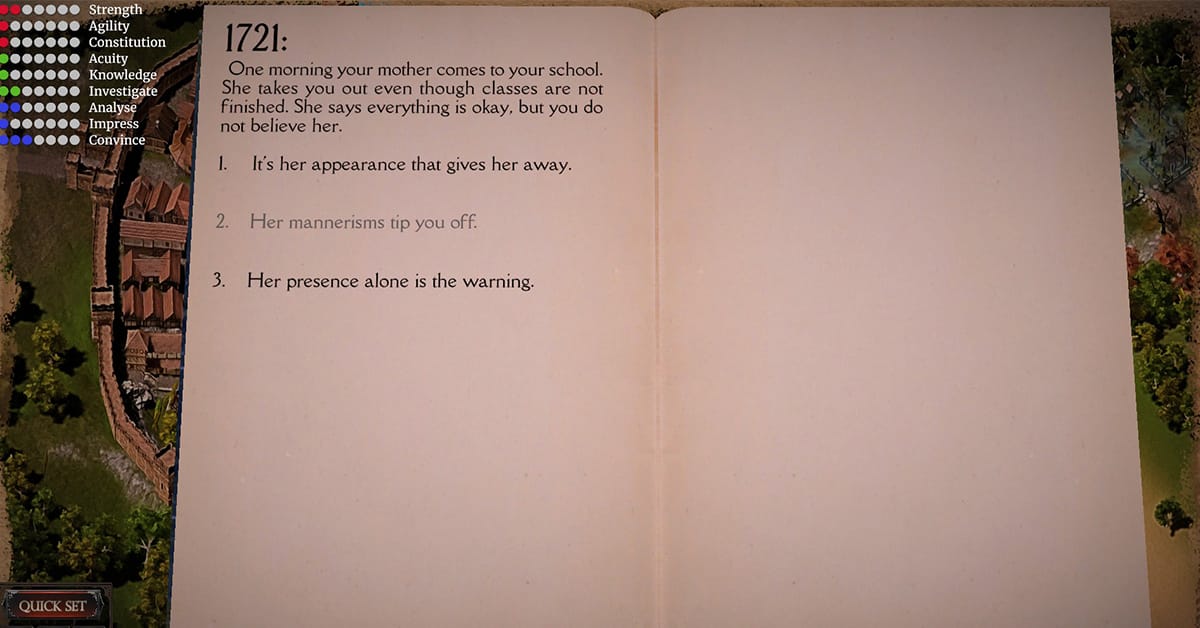
The Necromancer’s Tale lets you determine your stats in a refreshingly creative way. The introduction walks you through your younger years, but you get to decide how those moments played out. Pivotal events from your childhood are highlighted, and the way you choose to react during those memories awards you plus or minus points in various stats.
For example, if you decide your younger self stood up for themselves and fought back physically, you’ll earn an extra skill point in Strength; a handy boost during combat or when you need to do something like kick down a door. Opt for a choice where you notice something subtle that others would likely overlook, and your Analysis skill will benefit. This skill later allows you to catch NPCs in lies or read their intentions more accurately.
Other decisions affect your reputation with different factions, such as the Military, the Gentry, or the Outsiders (more on reputation later). And last but not least, your career path, something you can frequently reference or use during dialogue throughout the game.
When the prologue ends, you’re presented with an overview of the skills you’ve built so far. You can still tweak them if you’re not happy with the outcome.
I personally ended up as a charismatic diplomat, stacking points in the ‘Impress’ and ‘Convince’ skills. I love when a game allows me to let my silver tongue shine (just like I did in Kingdom Come: Deliverance 2). And, of course, it’s always a plus for the romantic escapades, which The Necromancer’s Tale certainly doesn’t shy away from.
That Was Almost as Long as the Game’s Intro; Back to the Present

Remember that ancient book of dark magic I mentioned being destroyed? Surprise: it wasn’t. The real story begins when your father dies under mysterious circumstances, forcing you, a nobleman of the Van Elstrik family, to return to Marns, the city where you grew up.
There, you come into possession of the powerful, sinister spellbook while trying to uncover the truth behind your father’s unexpected death. It doesn’t take long to realize that necromancy is the only way to bring the facts to light. The problem? You can’t understand a single word written in the darn book.
The Main Quest: Deciphering the Spellbook

Each chapter sends you on a quest to translate a single spell from the Spellbook. In one case, this means combining the book with notes you uncover in your father’s study. The result is usually the same: the page reveals a ritual along with a list of ingredients required to perform the spell.
And these aren’t exactly ingredients you can pick up at the local grocer. Think rare flowers, spider fangs, or cat hides (don’t worry, you don’t NEED to kill a cat for this).
Before you can even start gathering these odd shopping lists, you first need to find the proper clues. Information gathering is the core of the gameplay. You’ll spend about 90% of your time talking to the 150+ NPCs, each with their own compelling backstory and distinct personality.
Each NPC reacts to the protagonist in their own way, and you can often influence their behavior through your choices during conversations. Each character belongs to a certain faction and holds a personal opinion of your demeanor and past actions. Depending on your reputation with them, certain dialogue options may open, or close, entirely.
Confession: I’m Not a Fan of Reading. Yet Almost Every Conversation in the Necromancer’s Tale Kept Me Hooked

Since the vast majority of this game consists of reading, it lives or dies by the quality of its writing. Luckily, this is exactly where The Necromancer’s Tale shines. Despite the flood of text, reminiscent of the style in Disco Elysium, I never once got bored during the dialogues.
The very first time you speak with an NPC, they have a voice actor. This adds to the immersion and gives the characters extra personality, even though the voice acting probably won’t win any awards.
It also helps that your role in every conversation is significant. You can choose from different dialogue options to uncover more information. NPCs won’t always be willing to cooperate, especially once they start doubting your intentions. After all, Marns hasn’t forgotten its dark history with black magic.
Your Skills and the Skill Pool Can Open Doors That Would Otherwise Remain Closed, Sometimes Literally
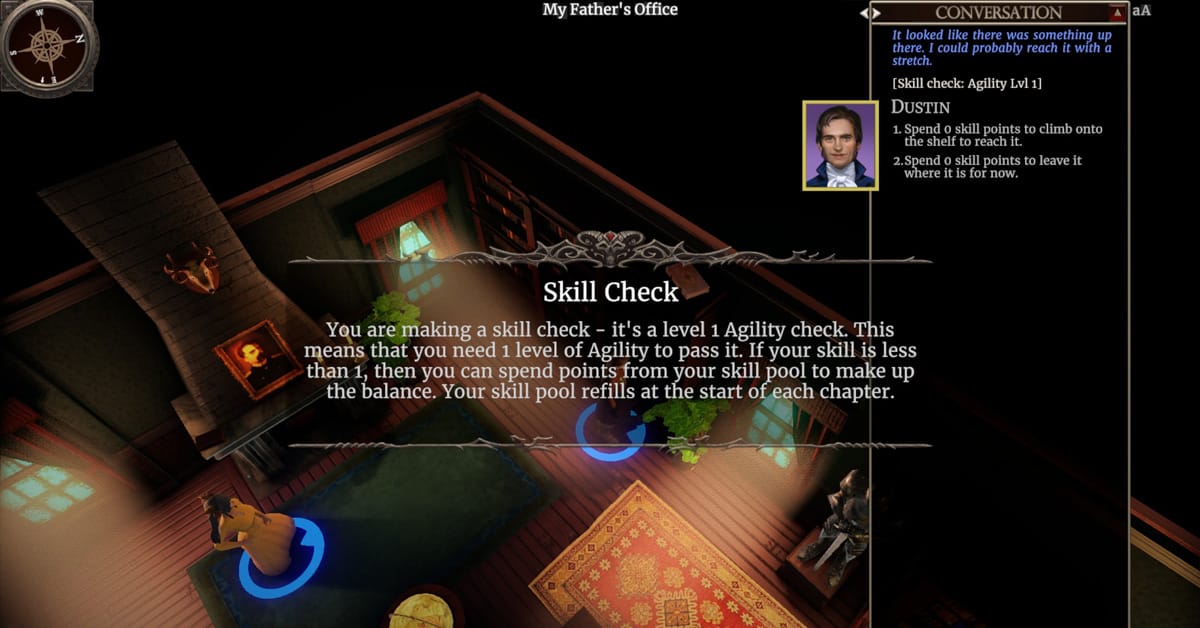
When an NPC digs in their heels, you have several options. You can look for another way around. One of the things I admire most about this game is that there are many paths leading to your goals. If one NPC won’t cooperate, there’s always another who might be more willing to help. And if that fails too, you can often find your way forward without intermediaries by exploring the environment.
But the most satisfying way is to cleverly win over that stubborn NPC. The game throws skill checks at you regularly. For example, there are moments when you can use your ‘impress’ skill to convince your conversation partner how crucial it is to find a certain rare flower.
If your impress skill isn’t high enough to push through, you can supplement it with points from your skill pool. On ‘balanced’ difficulty, you get a skill pool of 5 points per chapter. So if a task requires an impress skill of 4 but your character only has 3, you can spend 1 skill point from the pool to successfully complete the impress action.
If you run out of skill points in your pool, don’t despair. By wandering around the city, you might catch that same NPC in a compromising situation where they’d rather not be seen. Talk to them again, and under the pressure of possible blackmail, you’re likely to get the information you need.
So Much to Do, and So Much to Uncover

Besides ticking off the ‘shopping list’ of tasks required to progress the main quest, there’s a wealth of side content to lose yourself in. For example, you can take on one of several available jobs, earning some extra coins in each chapter.
You can also choose to help, or sometimes hinder, many of the NPCs by engaging with them and learning what’s on their minds.
Think of an arrogant tavern owner and his sister, who would rather see him out of the picture. Do you help her get rid of him? Or maybe assist the dockworkers by uncovering who’s trying to sabotage their business? There’s a lot to discover and get involved in throughout The Necromancer’s Tale.
In the more than 40 hours I spent in Marns, I still missed plenty of content. Toward the end, for instance, I met an NPC who apparently played a significant role and had quite a checkered past. The protagonist even thought, ‘I missed the chance to meet this person’, a clear hint. After watching some YouTube videos, it quickly became obvious there were many things I hadn’t resolved, and many NPCs I didn’t even meet in my first playthrough.
The game cleverly responds to what you do or don’t do by showing messages like, ‘Maybe I could’ve done more to bring this to a better conclusion’ when you finish certain activities. When you do solve something well, you often get to see the satisfying outcome of your actions, sometimes with fatal consequences.
This encourages you to explore thoroughly and dig into every corner of the city and its surroundings.
Exploring Can Be Fun, but Towards the End It Started to Lose Its Charm
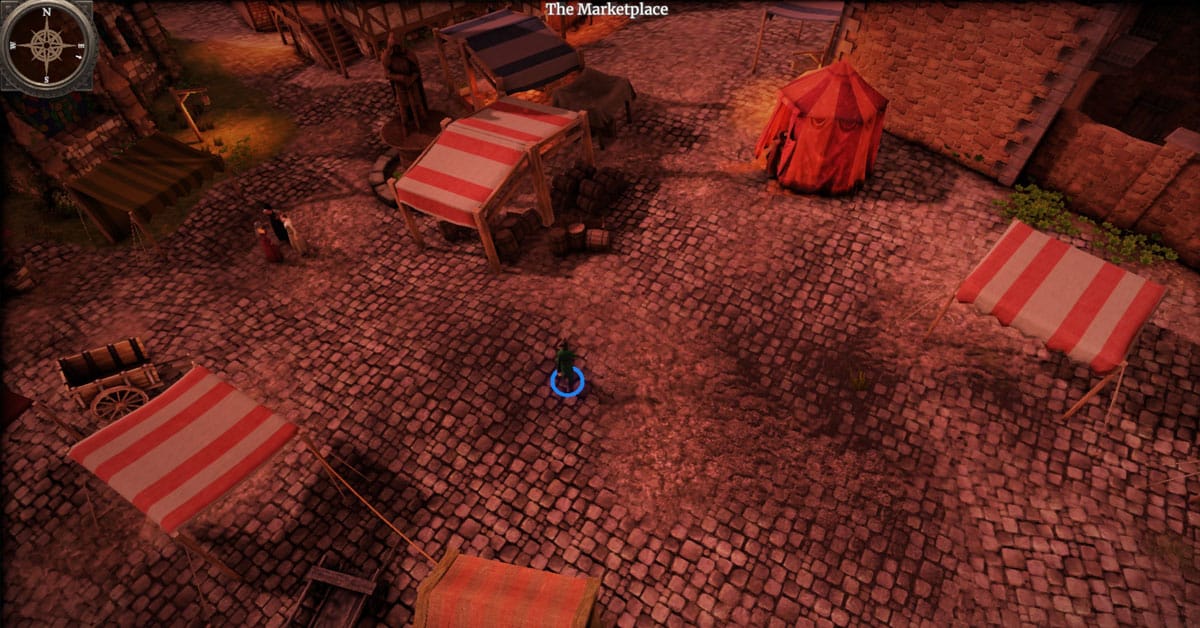
Besides all the talking, you’ll spend quite a bit of time walking around in The Necromancer’s Tale. Getting around the city is fairly simple and quick. You start with plenty of fast travel options, and when NPCs point out interesting locations, these get added to your map.
On the map you’ll find important places like taverns, a hospital, the cathedral, and various shops where you can buy and sell gear and weapons. You can open the map anytime and fast travel to any destination within the city with a simple click.
Some places are only open at certain times. While you’re outdoors in the city, you can advance the time yourself. Days are divided into morning, afternoon, evening, and night. So if you have an appointment in the evening, you can easily fast-forward the clock.
All well and good, but outside the city walls things get trickier. You no longer have access to fast travel, and worse, there’s no map either. The area outside the city is quite large and includes places like a farm, the Slums, a forest, and a graveyard.
Without a map, it took me a while to learn the right paths, and by the end of the game, walking these routes manually became a bit of a chore. That’s a shame, because there’s plenty of interesting and useful stuff out there beyond the city limits.
Naturally, you can still involve yourself in conversations and problems with various people, but you can also explore dark caves, chapels, and crypts. There you might find scrolls to add magical spells to your arsenal, or even dig up skeletons to add to your undead army. Watching that army grow larger remains one of the game’s highlights.
The First Time I Raised a Skeleton Was Incredible, and It Was Just One of Many

To stand against the evil in this world (or are we the evil?), you need an army. The title already gives it away: this happens by creating undead using your spellbook.
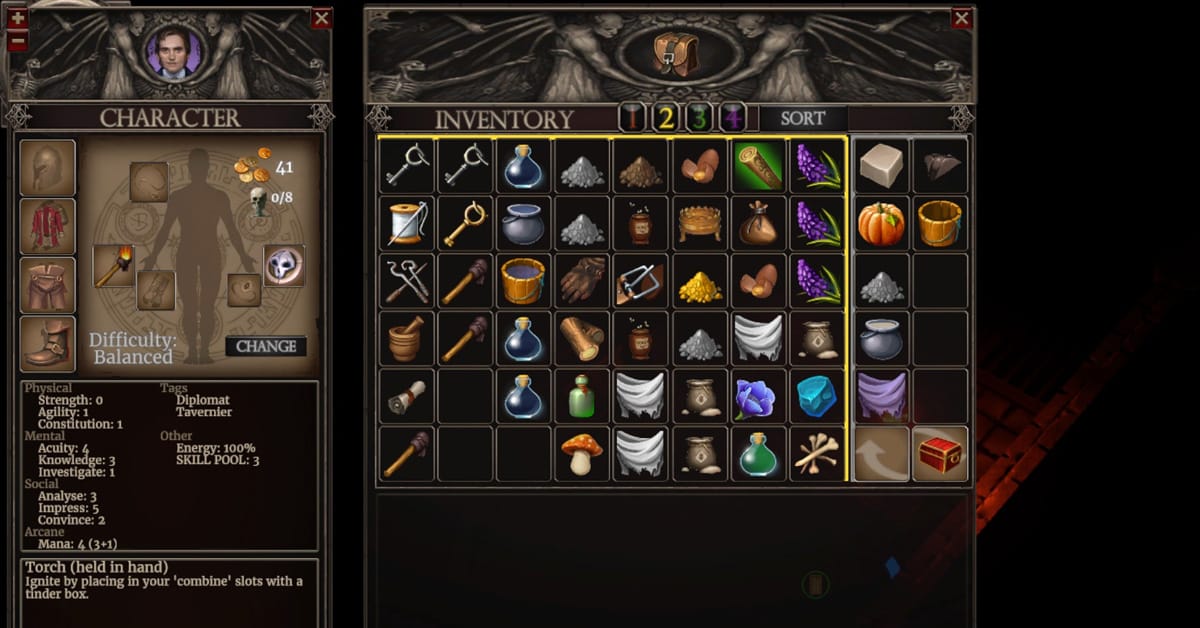
Once you’ve learned the spell, you actually need to find skeletons to bring to life. A logical place to start is the graveyard. Grab your shovel (yes, there’s a bit of chaotic inventory management), equip it in your hand (just having it in your inventory isn’t enough) and begin digging up skeletons.
Be careful not to do this in broad daylight. If witnesses catch you performing these gruesome acts, you’ll be punished and put on trial. It’s wise to carry out your dark deeds at night and protect your “workplace” with a shielding spell.
When you successfully unearth an intact skeleton, you can perform your ‘awaken’ ritual. The first time I managed to pull this off after all the groundwork felt amazing. PsychicSoftware does a fantastic job of capturing the slow descent into forbidden but powerful necromancy. It’s a true slow burn; you need patience leading up to key moments, but that patience is definitely rewarded.
“PsychicSoftware does a fantastic job of capturing the slow descent into forbidden but powerful necromancy.”
You can choose to explore and recruit more undead for your army at any time. At one point, I was walking through the dark forest, followed by dozens of loyal undead wielding swords and scythes. Pretty badass.
Of course, you don’t want to be seen with them, since that stirs up trouble in the city. That’s why I always left them behind in my family crypt, though you can choose other locations as well. You decide when they follow you or when they stay behind somewhere.
When you know combat is coming, you pick them up from wherever you left them. That definitely gives a powerful feeling, but honestly, I wish I could have used them more. The combat itself is somewhat underwhelming in both quality and quantity.
The Necromancer’s Tale Doesn’t Focus On Combat, and Maybe That’s for the Best

On one hand, it’s really cool to personally create such an army, but when you hardly get to use it, that feels like a missed opportunity.
The number of times I actually had to go to battle in The Necromancer’s Tale can be counted on less than two hands. Your choices can slightly increase or decrease this, but either way, don’t expect much combat.
And maybe that’s a good thing. The game isn’t exactly a natural at combat. It does what it needs to do. No more, no less.
Combat is turn-based. You have 5 Action Points, a certain amount of Magic Points depending on your Mana skill, and 100 Health Points (all enemies have the same amount of Action and Health Points). Every tile you move on the grid costs one Action Point.
Attacking also costs a few Action Points, depending on the weapon you choose. You can deal damage with swords, knives, pistols, muskets, and a few other weapons.
If you pick firearms, you have to reload after every shot. Reloading costs a lot of Action Points, sometimes taking more than an entire turn just to reload. The damage dealt is very high, so this mechanic feels balanced in that regard.
“There’s little strategy involved beyond keeping your protagonist safe (if he’s defeated, it’s game over). I usually kept him at a distance and let my companions do the dirty work.”
With your Magic Points, you can deal damage using spells like Poison Blast. This is also how you control your minions. You pick which skeleton or zombie gets the turn and then move and attack with that minion. You can keep repeating this until you run out of Action and/or Magic Points.
Since the game gives you a lot of freedom to build your army, balancing difficulty is tricky. At one point, I had gathered around 20 followers, making some fights on Balanced difficulty feel very easy. Players who spend less time recruiting their army will face more resistance at the same difficulty.
There are also fights where you don’t get to use your army. These battles are generally easy too. There’s little strategy involved beyond keeping your protagonist safe (if he’s defeated, it’s game over). I usually kept him at a distance and let my companions do the dirty work.
So players shouldn’t expect a challenging duel where they can unleash their inner mastermind. In that sense, it’s not so bad that the game has little combat, even if it does take away some of the dark magic thrill of assembling your undead army.
This Was One of the First Times I Played a Game That Barely Had Any Walkthroughs Available, and It Made Me Appreciate Them Even More

Up until the later chapters, it was almost always clear what was expected of me. The journal (which you can also add notes to yourself) gave me a fairly clear overview of what was still pending.
That said, the journal doesn’t record everything. Main objectives and important side quests are documented for you, but certain activities or appointments with NPCs aren’t always noted down. I actually appreciated this mix, as it kept me on my toes.
Towards the final chapters, however, I found myself having to search for solutions a few times. Since this is a new game, there isn’t much information out there yet. The Necromancer’s Tale reminded me once again how much I value the heroes who take the time to lay it all out for us.
Back to the core point: the journal became noticeably vaguer towards the end, and that hurt my overall experience. While the first chapters quickly and clearly guided me through the next steps, in the last chapters I sometimes wandered aimlessly around the map. At one point, I was even expected to be at a location I hadn’t discovered yet. Luckily, there was already a playthrough on YouTube that saved me from being totally stuck.
The following chapter felt much the same. All of this made the pacing towards the end weaker than it could have been, and that’s especially critical when you’re approaching the conclusion. Oh, Speaking of conclusions, it’s time for mine. But now before some loose scraps:
Some Loose Scraps
- A game that offers so many different ways to achieve your goals is naturally prone to bugs. I only encountered one, when a key story event overlapped with a date, forcing me to reload an earlier save.
- The circumstances surrounding your father’s death are presented as a twist, but I found it a bit predictable.
- The replay value is very high, though the developer could make it more appealing by allowing players to skip text with a single button press.
- A setting where you are the only one who practices magic is a fascinating concept, one I’d love to see explored more often.
- The developer drew inspiration from games like Ultima VII, Baldur’s Gate, and Disco Elysium.
- If this review hasn’t fully convinced you yet, there’s a demo version available on Steam.
Conclusion

The Necromancer’s Tale is absolutely worth playing if you don’t mind a game that’s heavy on text. Most of the experience unfolds through dialogue windows, and that’s exactly where the game’s strength lies.
The city, and especially its inhabitants, are genuinely interesting to get to know. The game rarely tells you outright what you need to do, but by exploring and talking to people, you’ll always stumble upon intriguing leads or activities that help you progress.
Combat doesn’t have much depth, which makes the impact of building your undead army a little less significant. The lack of a map and any fast travel outside of the city did take away some of my enjoyment toward the end, but that only happened after I had already spent about 40 hours having an enjoyable time with the game.